The digital transformation in education and payment methods

Avatar img
Estefania Cervantes Reyes
Redactora Creativa B2B
agosto 20, 2024
Lectura de 2 minutos
The digital transformation in education and payment methods

The digital transformation in education and payment methods

It is inevitable not to start every article we read or tell, taking the pandemic of 2019 as a reference. We are aware that the personal and business lives of many were split in two during those years. In that "starting from scratch", it has been interesting to see how the industry reinvented itself, and how people adapted to a new, more technological and virtual way of life. There has been an increase in the demand for various forms of digital education, and the interest of investors in companies that promote the development of work skills, even though today we can say that the pandemic disappeared relatively recently.

The evolution of education in the digital age

The expansion of digitalization and the development of online education have generated the need for reinvention in the education sector. As a result, the industry faces several challenges that need to be addressed to ensure a successful transition to a more digitalized educational model centered around user experiences. This sowed a seed with the name challenge for the education sector, which although it is certainly complex, teachers and students alike have been forced to look for ways to facilitate remote teaching and learning. As claimed by Statista, in Latin America, a region that was already struggling to provide adequate resources for an optimal learning environment, this situation has presented its own challenges. Inequalities are a constant, and circumstances vary both within and between countries.

Great challenges, but not impossible

The article: Impact of digital technologies upon teaching and learning in higher education in Latin America: an outlook on the reach, barriers, and bottlenecks, examines the degree to which digital technologies have been used to improve the educational process in Higher Education Institutions (HEIs), as well as the barriers and challenges that could explain why their implementation has not been uniformly effective in all HEIs. The research was carried out in nine Latin American (LATAM) countries, selected according to the prevailing perspectives of educators, business and financial investors. Its objective is to highlight the level of impact and implications of information technologies on teaching and learning processes.

According to the article, despite the commitment evidenced by LATAM countries to accelerate the transformation towards digital technologies in their educational environment, through the development of action frameworks and plans based on Educational Technology (TEL, in Spanish) policies, there is a lack of local capacity for the creation and design of specialized educational technologies. These tools could be used to improve teaching and learning processes in various Higher Education Institutions (HEIs) in the LATAM region, unlike what happens in European countries.

Opportunity Box

While there is a significant challenge in education and digital payments in LATAM, several countries are making efforts to expand their presence and support through programs that impact the education sector. Here are some figures from Statista.com, with respect to countries such as Mexico, Ecuador and Peru:

  • Mexico: Revenue in the online education market is projected to reach $793.10 million by 2024.
  • Peru: Revenue in the online education market is projected to reach $128.60 billion by 2024.
  • Ecuador: The total value of transactions in the digital payments market is projected to reach $10.74 billion by 2024.

In summary, didactic elements and models are being developed to ensure that students' learning and training experiences are maximized, even in circumstances such as those of a pandemic. Thanks to trends and advances in digital technologies, digital technologies have become an integral part of the modern educational models of higher institutions, as well as an effective tool for the development of disciplinary and transversal competencies, and the promotion of a memorable and flexible university experience.

An impact for the future of society

Recently, a qualitative study was conducted in Brazil and Mexico to evaluate the impact of educational technologies in the educational field (Jassir, 2018). Based on the findings of this study, the aim is to develop educational programs that help accelerate HEIs' plans towards developing and improving their digital transformation strategies, providing a roadmap for the future of education and sustainability.

This is how Kushki enters the education and payment markets

At Kushki we are dedicating significant resources to technological innovation to integrate the various channels with payment systems. The digital environment is constantly evolving, requiring continuous updating and improvement of user experience and multi-channel strategies to keep up with industry trends and consumer expectations. The market is increasingly demanding ease and speed in payments. For this reason, having tools that facilitate recurring charges is essential.
education

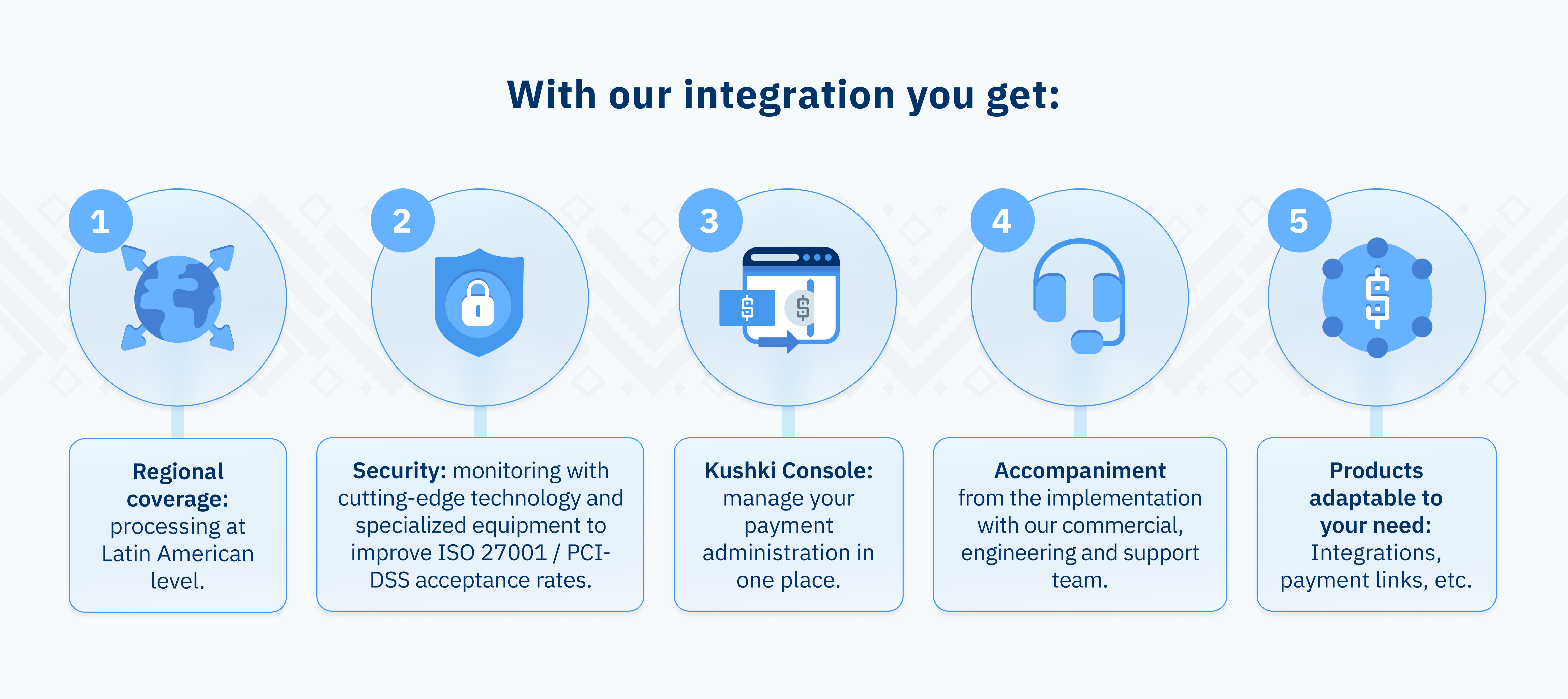
Kushki offers a variety of tools designed for this purpose:

  • Online payments by credit card, debit card, bank transfers or cash payments.
  • Reduce the ratio of non-performing loans, due to lack of timely payments.
  • Ease and agility on platforms with UPTIME availability
  • of 99%.
  • Regional processing that allows us to replicate best practices in different markets.
  • Modern technology based 100% on the cloud.
  • Card subscription to make recurring payments.
  • Payment links that facilitate the collection of delinquent portfolios.
  • Consolidated settlement reports on sales made with any payment method or card brand.
  • Online administrative management console.
  • Reports where the different mechanisms of digital payments, transfers, card payments, among others, are consolidated.

Contact here an advisor to learn how our solution offers your customers greater ease and agility to integrate with the same API for LATAM and expand your business without complications!

Sé el alma de la fiesta con la información más fresca sobre pagos digitales.

Suscríbete a nuestro Kushki Hub para recibir alertas de nuestro nuevo contenido.

Suscribe illustration
¿No sabes qué producto es el indicado para tu comercio?
¿El mundo de los pagos llama tu atención?

Más de nuestro Kushki Hub

Speed up your payment response times with Kushki and latency optimization

Nowadays there are so many similar products and services in extreme demand, that even the smallest detail counts for a user to decide between one or the other, even in the time it takes to confirm a payment. In this article, we will discuss how optimal payment processing latency provides a better quality of service for your users and the operation of your business. Lower latency = Better service The optimization in Kushki's transactional times that your business needs. What is latency? In general terms; the latency is defined as the time it takes for data to be transferred through the network. Networks with a longer delay are considered to be high latency networks, while those that process faster response times have lower latency. When we bring the term latency to the world of payments, we are talking about a fundamental and even critical issue for efficient transactions, since large companies need it, especially for payment service processors (PSPs) or for orchestrators that need to serve their users in real or near-real time. Why does low latency offer a better service for those who handle enterprise merchant charges? Having low latency in your e-commerce, mobile app, streaming services and others; impacts in multiple positive ways to both PSPs or orchestrators, as well as the end user: - Improved user satisfaction: The faster and more efficient the payment process, the more highly valued the service will be, which may define the loyalty and retention of that user. - Increases conversion: Reduced latency times lead to higher conversion rates. The faster and simpler the purchase process, the more likely consumers are to complete it. - Reduce shopping cart abandonment: When the checkout process is slow, complicated or requires many clicks to complete the purchase, customers may abandon their carts before completing the transaction. By improving latency times, we reduce this probability. - Increased operational efficiency: Processing payments faster and more efficiently can positively impact the costs associated with transaction management. - Boosts competitiveness: In sectors such as transportation contracting, sports betting, gambling, e-commerce or financial services, where speed is key, low latency is an important competitive factor to gain an advantage over competitors. How to improve latency for businesses that process high volumes of transactions in seconds? UNIFICATION Most payment platforms that process enterprise merchant charges have 3 simple steps to quickly credit a transaction: Tokenization Preauthorization Capture At Kushki we optimize the transactional response process by unifying tokenization and pre-authorization, thus achieving low latency and a better user experience. It should be noted that for security and sensitive data management reasons, this unification is only available for enterprise businesses, PSPs, orchestrators and others that have their PCI compliance certification active. Every second counts! Leave your competitors behind and accelerate your business with Kushki, the regional non-banking acquirer that offers you low latency on every transaction. Contact a consultant here and let the race begin!
Avatar img
Steff Cervantes
Redactora B2B
agosto 15, 2024

Latin America: A Rising Opportunity for International Payment Service Providers and Large Merchants

As global e-commerce thrives, many international markets are witnessing diminishing returns due to high competition and saturation. In contrast, Latin America (LATAM) represents a burgeoning opportunity for Payment Service Providers (PSPs). With digital commerce expanding at an impressive 20% annually, with consumers across LATAM increasingly embracing digital payment methods. The region is forecasted to reach nearly $950 billion in online purchases by 2026, with international transactions accounting for a significant share. Vertical segments like, gambling and gaming are poised to grow at a compound annual growth rate (CAGR) of more than 18% by 2028, presenting a lucrative landscape/playground for PSP's. Challenges of a Direct Go-to-Market Strategy in LATAM While the potential is vast, entering and expanding across Latin America poses unique challenges for International PSPs and clients aiming to navigate the market independently. Fragmented Legal and Regulatory Environment Each country in Latin America has distinct legislation governing business operations, tax codes, and the legality of various sectors, such as sports betting and casinos. Compliance with these diverse regulations is daunting and can significantly delay a PSP independently tackling each country in turn impacting their return on investment. Complex Bank Relationships and Integrations Setting up local business entities and contracting with regional banks involves navigating bureaucratic hurdles, legacy technology platforms, and sub-standard support. PSP’s must integrate with multiple systems, often outdated and complex, requiring significant effort from development teams. Multiple Payment Gateways and APMs PSPs must partner with numerous local and alternative payment method (APM) operators to allow customers—including the unbanked and underbanked—to transact using their preferred methods. Establishing legal entities, coding, testing, and certifying disparate systems makes it challenging to launch a competitive platform that supports all preferred payment methods. Cross-Border Processing Costs Transactions not processed in local currencies often decline due to higher perceived risk. Plus, cross-border transactions are 4-5 times more expensive than local ones, adding friction and cost. Not offering popular APMs can significantly impede revenue generation. Security and Risk Management Dealing with multiple banks and processors leads to inconsistent risk management and increased fraud. It also complicates PCI DSS compliance, making it harder for PSPs to ensure secure transactions and maintain visibility into decline reasons and chargebacks. Kushki: The Key to Success Across LATAM Simplifying LATAM Expansion for PSPs Kushki offers a streamlined solution for PSPs looking to capitalize on Latin America’s growth potential without incurring the associated complexities and costs. Our extensive LATAM presence, licensing, connectivity, risk adeptness, and experience make us uniquely qualified to be the partner PSPs everywhere trust to enter the region, grow and scale their business, and meet their customers' evolving payment demands. Deep Local Payment Expertise Kushki's extensive local presence across LATAM and its licensing, connectivity, and expertise make it an ideal partner for PSPs. By connecting PSPs to multiple LATAM countries via a single API, Kushki simplifies pay-ins, pay-outs, and advanced fraud management for various payment methods; including cards, bank transfers, digital wallets, subscriptions, and installments. Reduced Costs and Complexities With Kushki, PSPs can reduce operational costs and complexities by consolidating multiple acquiring relationships into one under our non-bank acquiring licenses with Visa and Mastercard. This unified approach streamlines regional acquiring, offering consistent underwriting, risk management, transaction routing, and support. Streamlined Integration and Faster Market Entry Kushki's universal platform facilitates seamless integration and last-mile connectivity to over 80 card networks, banks, and local/alternative payment methods (LPMs/APMs) across five countries. One relationship supported by a single API speeds time to market and allows PSPs to scale efficiently across the region without the overhead of establishing legal entities in each country. Enhanced Transaction Processing Kushki improves transaction processing by combining global and local capabilities. In-country processing reduces declined transactions, enhances authorization rates, and accelerates funding. Sophisticated fraud tools and detailed insights into transaction data further optimize performance. Superior Customer Experience Kushki enhances the customer experience by offering a wide array of payment types, including credit cards, installments, subscriptions, and digital wallets. PSPs can provide their clients with the payment flexibility they demand—backed by friendly and knowledgeable local support teams—fostering deeper customer relationships and increasing lifetime value. How Kushki Helps PSPs Unlock Success and Scale? Kushki supplies the technology and operational resources so PSPs can concentrate on doing what they love without getting mired in the overhead of card schemes, local laws, payment methods, and banking bureaucracy. By expanding confidently, PSPs can maximize revenue and grow their business, even entering untapped markets and vertical segments. PSPs can trust that their processing is safe and secure and backed by a financially solid, and proven company with an entrepreneurial spirit dedicated to driving the digital payments revolution in Latin America. In 2023, Kushki processed 140 million transactions in cards, transfers, cash—valued at US$15 billion. Kushki’s unique positioning and extensive capabilities make it the key to unlocking LATAM's payment opportunities. It enables PSPs to act locally while thinking globally. Whether navigating the regulatory landscape, integrating multiple payment methods, or managing risk, Kushki provides the support and resources PSPs need to thrive in Latin America. Ready to grow with Kushki in Latin America? Talk to us today.
Avatar img
Sherrie Rogers
Sherrie Roger - GM Global Sales Kushki
agosto 13, 2024

Detrás del juego: ¿Cómo se comportaron los aficionados al fútbol durante la Copa América y Eurocopa en las casas de apuestas?

Era de esperarse que el equipo albiceleste levantara nuevamente la Copa América este año, tanto así que hasta el reconocido peleador británico de MMA, Connor McGregor apostó US$365.000 a favor de la selección de Messi, apuesta que le hizo ganar US$1.103.021. No sabemos con exactitud si McGregor es verdadero fanático del equipo argentino, o del equipo español, ya que también apostó una absurda cantidad de dinero por ellos en la EuroCopa, lo que le dejó otra ganancia de US$1.101.098. Pero en el mundo de las apuestas, no todo es fanatismo por un equipo. Apuestas: ¿Entretenimiento o negocio? Las apuestas se dividen en dos sentidos entre los millones de usuarios: la primera es la pasión por su equipo favorito, la emoción e intriga; y la segunda se basa más en las deducciones donde entra el conocimiento del juego, los jugadores y sus últimos desempeños en el campo. De hecho, existen personas que se dedican a tiempo completo a las apuestas como un negocio en el cual generan bastante dinero; esto claro, si son lo suficientemente capaces de armar las mejores estrategias y conocer al 100% cómo funciona este ‘’juego’’. Copa América: ¿Quién conquistó las cuotas en las casas de apuestas? Horas antes de que la Copa América comenzara (20 de junio), las casas de apuestas ya tenían sus pronósticos sobre quién podría ser el siguiente campeón: Argentina, Brasil y Uruguay, estaban entre los favoritos. 16 selecciones, 32 partidos y 14 estadios de Estados Unidos; así se definiría todo. La tabla de las cuotas de ganancias en general para los apostantes en las casas de juegos consultadas se formaron así: Pero como en cualquier juego, el resultado es incierto. Según las predicciones, Colombia tenía bajas probabilidades de ganar (6%), mientras que Brasil, un país con jugadores legendarios en la historia del fútbol y siendo uno de los favoritos no solo de LATAM, sino del mundo; contaba con una probabilidad de victoria de entre el 14% y el 23%, y para sorpresa de todos, fue eliminado en los cuartos de final. La sorpresa para los fanáticos de este deporte no terminó ahí, ya que Colombia no solo destacó en la Copa América, sino también en las apuestas en línea. “Calculamos que las apuestas deportivas en línea podrían subir entre un 30% y un 40%, dependiendo de hasta dónde llegue la selección en la Copa.’’ Evert Montero, presidente de Fecoljuegos. No solo los colombianos apostaron con toda a la Copa América, los hinchas también entraron al terreno europeo para apostar en la Eurocopa; jugada que hizo que efectivamente las apuestas continuaran subiendo, empujando el porcentaje más hacia el 40%. Cabe destacar que en Colombia, parte de los recaudos de las apuestas se destinan al sector salud y se transfirieron $117.068 millones al sistema sanitario gracias a las apuestas deportivas. Eurocopa: ¿Quién conquistó las cuotas en las casas de apuestas? No comenzó en el top de los favoritos al título, pero tampoco para catalogarlo como sorpresa. Era de esperarse que España pasara a cuartos de final según los expertos y los apostadores. No obstante, al eliminar al equipo anfitrión en los cuartos de final detonó los créditos a su favor. Francia, Inglaterra y los Países Bajos no se quedaron detrás. Llegaron por méritos propios. Algo que llamó la atención fue lo sucedido con el equipo inglés, que aunque el favoritismo era grande, no ofrecía un compromiso verdadero para su plantilla. La tabla de cuotas de ganancias de la Eurocopa estaba dividida de la siguiente manera: Perú: un país con pasión por las apuestas y la tecnología en medios de pagos Según un análisis de las transacciones realizadas en 1.533 casas de apuestas y lotería en Perú, las apuestas digitales crecieron a doble dígito durante ambas Copas. En el caso de la Eurocopa, las apuestas digitales aumentaron 86% en volumen y 125% en número. Mientras que en la Copa América, las apuestas se incrementaron a un 65% en volumen y 130% en números durante los partidos de definición de semifinales. Durante la hora previa a los partidos, el análisis identificó que las transacciones asociadas a la Eurocopa y la Copa América aumentaron 153% y 120%, respectivamente. Además del desafortunado desempeño de Brasil y el ímpetu de Colombia en esta Copa América, otro dato a destacar, es que el análisis observó una expansión significativa del uso de billeteras digitales para efectuar las apuestas digitales en Perú. Para la Eurocopa, el uso de este medio de pago aumentó 140% en volumen y de 151% en número de transacciones; y para la Copa América, de 139% en volumen y 167% en número. Este fenómeno resalta la preferencia de los usuarios por medios de pago rápidos y convenientes para efectuar sus apuestas. México: un país apasionado por el fútbol y las apuestas México es cuna de apostadores, tanto así que el mercado de las apuestas deportivas en línea está proyectado para alcanzar US$1.24bn (miles de millones) este año; mientras que el CAGR entre el 2024 y 2029, se estima que suba un 8.45%, es decir, un volumen de US$1.86bn (miles de millones) para 2029. A pesar de que Colombia y Perú se llevaron los mejores porcentajes en términos de apuestas en esta temporada de Copas, México continúa a la alza en este gremio, y no solo eso; Brasil, siendo el gigante no solo del fútbol, sino de Latinoamérica, su ranking en las apuestas queda muy por debajo de las estadísticas mexicanas. Se pronostica que hasta el 2028, alcance al país azteca en volúmenes de revenue por apuestas en línea. México, a pesar del amor por el juego y las apuestas, no cuenta con un equipo de primer nivel para mínimo llegar a la final de una Copa, como lo es la Copa América, pero sin lugar a dudas las regulaciones y certificaciones para las casas de apuestas legales, han hecho de este país un paraíso para los que gustan de los juegos de azar y las apuestas deportivas, lo que atrae cada vez más a inversionistas externos que quieren comenzar en este negocio y a actores internacionales que ya cuentan con casas de apuestas. Cada vez, las apuestas van ganando más participación por LATAM no solo gracias a las nuevas regulaciones, también entran factores como la tecnología, los nuevos medios medios de pagos alternativos, la inclusión financiera, el acceso a internet y el poseer un teléfono móvil, etc. Datos de la Eurocopa y la Copa América comparados con su última edición* Apuesta con Kushki y llévate el premio mayor con todas la soluciones y productos que tenemos para tu negocio enterprise. Contacta a un asesor
Avatar img
Steff Cervantes
Redactora B2B
julio 24, 2024