From 2006 until Today: The History and Development of Payment Gateways

Avatar img
Magdalena Ovalle
Líder de Comunicaciones Internas @ Kushki
septiembre 29, 2020
Lectura de 2 minutos
From 2006 until Today: The History and Development of Payment Gateways

The history and development of payment gateways

Since the first payment gateway appeared 14 years ago, a lot has happened with these tools that are key to the world of electronic commerce and digital economy. Although the term was already used for the first time in the United States in 1996, when the young engineer Jeff Knowles founded Authorize.Net, the truth is that it was developed for processing only credit card payments, and remained that way for many years, even after the company was acquired by Go2Net Inc in 1999.

With the pandemic and the boom of e-commerce, digital payment platforms and other fintech vertical platforms have become more significant, increasing dramatically the investment of companies in this sector and even their profitability. This is an industry that, just some years ago, had been advancing at a more paused pace, but today, it poses great challenges to countries, given the speed at which it is evolving.

Who were the Pioneers?

The first payment gateway (defined as the service that allows a merchant to accept all payment methods through internet, automate operations between customers and merchants and centralize information) was Adyen, created in The Netherlands. Founded in 2006 by a group of young entrepreneurs, including Pieter van der Does and Arnout Schuijff, its main objective was making the businesses grow in a country where, despite being economically developed, payment technologies were becoming increasingly obsolete.

They decided to name the company Adyen because in a Suriname's creole language it means “to start again”, which made sense with the idea of building a modern infrastructure to connect first, The Netherlands, and then, the whole world. Today, it is the payment platform that giants such as Uber and Spotify use, and it has offices in 22 cities around the world. In 2019, they processed 240 trillion euros.

The Local Reality

In Latin America, the development of the payment gateways has advanced at a slower pace, but it is not less relevant. In a region where, according to Brookings Research Center data from Mexico, Colombia, and Peru, less than 40% of the people have formal bank accounts, the development of the fintech industry, and specifically, of digital payment gateways, has become more necessary than ever.

In this context is where Kushki and many other companies and startups are created for payment processing, financing, financial infrastructure, personal financial management, insurtech and digital assets negotiations, among other activities. In 2018, according to a study by FinteChile in collaboration with EY, the Latin American fintech industry counted up to 55 investments for a total of US$500 million. With the pandemic, the investment increased dramatically: according to quantitative data by KoreFusion Consultancy, the fintech sector in Latin America reached historical investment values for US$8 billion, a payment category that accounts for a 50.5% of the total.
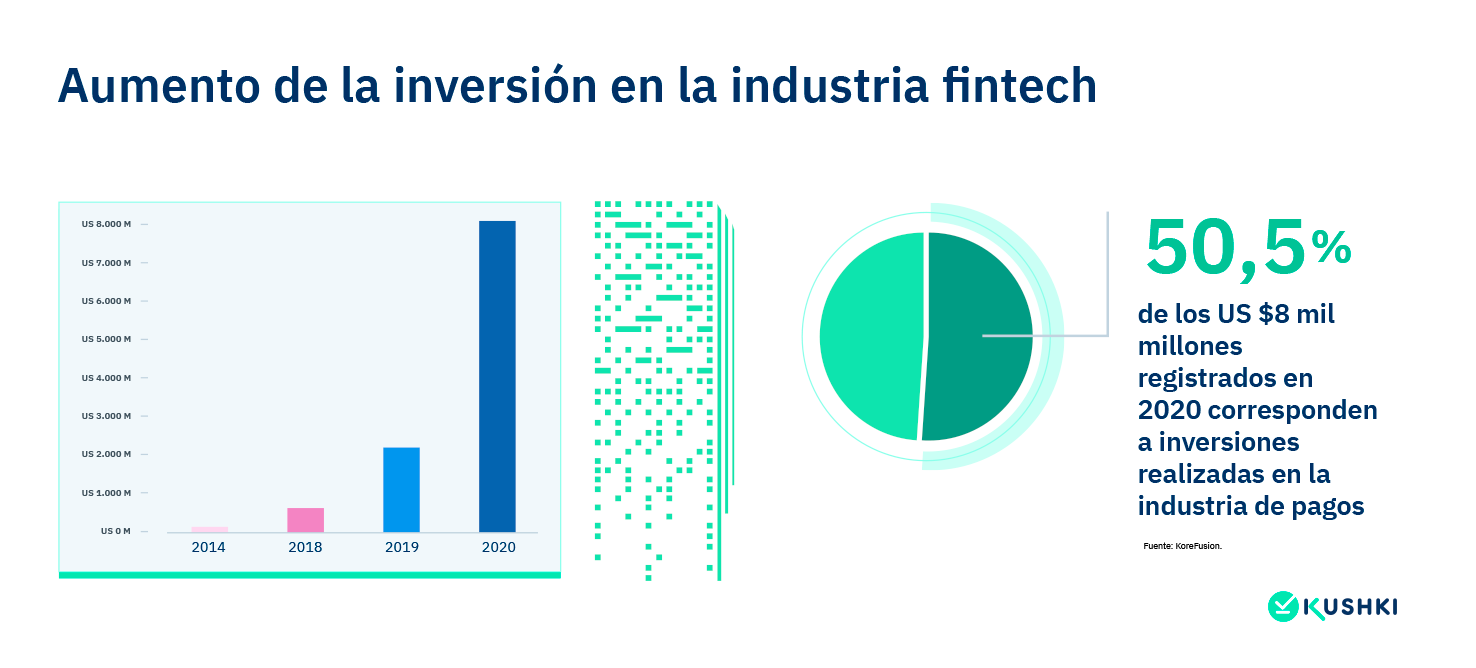
Fintech Investment in Latam

Until 2018, only in Chile –one of the countries with the highest bancarization rates in Latin America– online banking users had doubled during a period of five years, reaching 9.3 million in 2017, according to the Association of Banks and Financial Institutions of Chile (ABIF, in Spanish). A 70.3% of the customers used banks websites and among them, 34.5% connected to banks from a mobile device. By mid 2017, Law 20.950 was promulgated in Chile, establishing the legal framework for payment gateways, among other provisions concerning payment cards.

In Colombia, payment gateways appeared massively in 2011, after the creation of the Colombian Chamber of Electronic Commerce in 2008. Before that, the main operator was Pagosonline, which changed its name to PayU Latam. In June 2020, payment platforms operations increased by 64% compared to 2019, as a result of the pandemic. Some of the best known digital payment platforms in that country are PayU Latam, PlacetoPay and ePayco, among others. In this scenario, Kushki has been progressing together with state entities such as the Superintendence of Notaries and Registry (SNR, in Spanish) and the Single National Registry of Vehicles and Drivers (RUNT, in Spanish), digitally transforming analogous processes and making them more accessible for the general population.

A study about e-commerce in Colombia's neighbor, Ecuador, conducted in 2017 by the Ecuadorian Chamber of Electronic Commerce, revealed that the most used method to pay in e-commerce transactions is credit cards (61%). Debit cards follow them by far, accounting for a 17%, and cash is the least used, accounting for only 8%. In Ecuador several platforms operate and, among them, the most important are Kushki, Paymentez and PlacetoPay.

Mexico, Peru and the Way ahead

A little behind, but advancing quickly, we find Peru. According to 2019 data by the Inter-American Development Bank (IDB), the country had 81 fintech enterprises, most of them payments and remittances (27.2%). The main sponsor is the Ministry of the Production (PRODUCE), with a non-refundable seed capital that, since 2016, has contributed $ 2.7 million Peruvian Soles. Although there are some popular payment gateways, cash transactions continue to be strong, with PagoEfectivo positioned as one of the most used. There is still a lot to do: According to some studies, four out of ten Peruvians mistrust online purchases and payments.

Some of the best opportunities can be found in Mexico, one of the biggest countries in Latin America and the second most important economy of the region. There, cash is still the king. It is not a coincidence to see long lines of people in front of ATMs waiting to withdraw money at the beginning of each month. Although Mexico was one of the pioneers of the region after promulgating a Fintech Law, their bancarization level is the lowest in a group that includes developed countries such as Spain, and emerging economies such as Chile, Argentina and Peru. According to the National Banking and Values Commission, only 12% of the Mexicans owns a credit card. All the above, place this country as one of the greatest territories where digital payment platforms can earn more space. Kushki has recently opened a branch in this country some months ago, where also Conekta and Stripe have operations.

In six years, the Latin American fintech ecosystem has grown exponentially: It went from being a financial market US$50 million worth to reach US$2.1 trillion, closing 139 venture rounds in 2019. In addition, Latin American countries are the fastest adopters of mobile internet, reaching a 66% of the population versus the global average of 53%. This is an industry that moves faster than regulations at each country; regulatory agencies will now have to catch up with the technological acceleration that has resulted from the worldwide pandemic.

Be the life of the party with the latest information on digital payments.

Subscribe to our Kushki Hub to receive alerts about our new content.

Suscribe illustration
Don't know which product is right for your business?
Does the world of payments catch your attention?

More about our kushki Hub

Canary Deployments and how to sleep peacefully at night

Canary-type implementations Today, you will learn about a technique where code deployed to production will not be replaced instantly by the previous code, but within a time frame and under a controlled environment, so you can sleep peacefully at night. It is a widespread idea that the only way technology companies can deploy their code to production is at non-working hours and opening maintenance windows for their clients. This is an old practice adopted by big companies, and it works to some extent, but at what cost? At the cost of having a dedicated team for those deployments, extra hours, night schedules and a significant workload for employees and companies. In addition, when introducing new features to production, even after full tests have been performed (point-to-point testing and unit testing), there is always the risk of the human factor, because nobody is perfect and something can fail. For this reason, companies prefer to deploy code at non-working hours. To solve these overwhelming problems, that often deprive software developers from their precious sleep, canary deployments were invented. A canary deployment is a technique where code deployed to production is not replaced by the previous code instantly, but within a time frame and under a controlled environment; errors, statistics and other features are monitored to replace the complete code or to roll back to the previous one. This, my dear reader, is what I will tell you in this article. Flow chart of a canary deployment, before, during and after deployment. Canary deployments were developed precisely to satisfy the need and the obsession of software developers to achieve control over even the smallest detail of a deployment to production. Nobody likes inserting bugs in production, but they are something we all programmers have had to deal with, and we know that they will not disappear because they come from the imperfection of human nature. Nevertheless, we can reduce those bugs to the minimum and, if they occur, they can be limited to just some components and non-critical features of a product or a service. We can minimize them in both number and impact to the product. Canary deployments introduce a new version of a developed code and release it for a small part of the users, gradually increasing the number of users with access to it within a specific time frame. For example, you can launch a 10percentEveryMinute deployment, which means that at the first minute of deploying the code to production only 10% of the users will be using it, while the remaining 90% will continue accessing the old code. The usage percentage of the new code will be gradually increased until total deployment has been achieved. A gradual deployment may be accompanied by automated monitoring alarms that detect the error level of the code that is being tested, if it is higher than the threshold, an automatic rollback will be performed. A rollback is understood as aborting the new deployment to production, a functionality that is generally used when errors were found in the new code. Likewise, you can complement alarm monitoring by running functions before and after starting the deployment, in order to ensure that the code being tested does not cause any problems. The idea is running a test system using the old code we know is working in the first stage, and then repeat the test using the new code. This allows us to prevent a random deployment that unluckily has hidden any potential bugs during deployment due to simple statistics. In this way, canary deployments help us to: Perform deployments to production under a controlled environment. Roll back easily. Version code in production. Reduce bugs significantly. As we can see, canary deployments have a lot of advantages, well-received by developers when releasing code to production. However, I want to put in perspective that if statistics are poorly read, this might cause aborted deploys due to results full of false positives from errors that actually never occurred. During deployment, some problems caused by integrated suppliers or third parties may occur, and, when error measurement is performed automatically, deployment might be also canceled automatically, taking these third parties problems as if they were ours. This reinforces the need to establish more control mechanisms. Although they will make the process of release to production longer, they also will reduce the error rate, and we will avoid false positives. Below you will see a practical example of a canary deployment using Serverless Framework. You will find the framework reference here: https://www.serverless.com/ The canary plugin is here: https://github.com/davidgf/serverless-plugin-canary-deployments. You can configure a canary deployment in a very simple way by using the structure of a serverless project with the following lines of code: A canary deployment is configured in a very simple way by using the structure of a serverless project with the following lines of code: Step 1: Install the plugin version in the package.json file js "serverless-plugin-canary-deployments": "0.4.8" Step 2: Reference the plugin in the 'plugins' section of the serverless.yml file yaml plugins: - serverless-plugin-canary-deployments Step 3: Set up the options of the canary deployment you will use. In this example, we will specify two alarms, the environments where the canary deployment will be applied and the type of deployment. yaml deploymentSettings: stages: - ci - qa - stg - uat - primary type: 10percentEvery1Minute alias: Live alarms: - ErrorChargesGatewayAlarm - ErrorChargesCountAlarm Step 4: Reference the configuration of the canary deployment in the lambda function to be applied. yaml functions: record: handler: src/handler/RecordHandler.HANDLER${self:custom.deploymentSettings} And that's it! We have analyzed much of the pros and cons that we can find in a canary deployment, from the concept to a practical example of how to make it functional. Without a doubt, the use of this technique is becoming an increasing trend in the world of software development, as it minimizes errors in the critical components of a software system, allowing developers to sleep peacefully at night.
Avatar img
Patricio Moreano
Tech Lead @ Kushki
septiembre 16, 2020

Powering the Development of the Real Estate Sector with MobySuite

Driving the development of the real estate industry with MobySuite Digital media have set an important milestone in the commercialization of goods and services, and the real estate sector is not an exception. Digital platforms already were the preferred means for the purchase and rent of properties. Then, the COVID-19 pandemic forced us to confinement, increasing the need of businesses to adopt new technologies and transform themselves digitally. Given this need, PropTech (property technology) enterprises keep finding the best way to apply technology to the refinement, improvement and reinventing of the real estate sector. One of these companies is MobySuite, which, with its real estate software 100% online, supports the property purchase process from the first contact by the potential owner to the time of handing over the property. They provide assistance in customer service (in-person and remotely) and also in the reservation and payment management process. In this way, Mobysuite improves the experience of property purchase and selling by providing help and opening possibilities for all the stakeholders involved in the process: For buyers, to make the payment of their installments remotely. For real estate agencies, to automate their business flow and keep it updated in real time. For customers (property owners), to make reservation agreements for property, to pay reservations (with Visa and Mastercard), and download agreements in an easy and automated way. Among other things. The role we play in LatAm development Our commitment to promoting the development of the LatAm economy is what keep us together. In the end, we all want to generate the necessary transformation in the financial and real estate market, working with passion and developing the cutting-edge technologies adapted to the needs of customers and users. Together we offer a solution for real estate agencies so that they can manage their processes safely, efficiently and intuitively. Making possible on their part, the access and payment of real estate services for customers who need them, thus keeping the economy of these countries in motion.
Avatar img
Stella Vargas
Líder de contenido @Kushki
agosto 25, 2020
From 2006 until Today: The History and Development of Payment Gateways