Ecuador and its digital ecosystem: what opportunities exist?

Avatar img
Magdalena Ovalle
Líder de Contenido @Kushki
octubre 19, 2022
Lectura de 2 minutos
Ecuador and its digital ecosystem: what opportunities exist?

Together with Americas Market Intelligence (AMI) we come to talk about Ecuador. A medium-sized country, but dollarized and with a highly loyal population to banks and financial institutions. What opportunities do fintech companies have there and what is the industry like? Here we tell you.

Country context

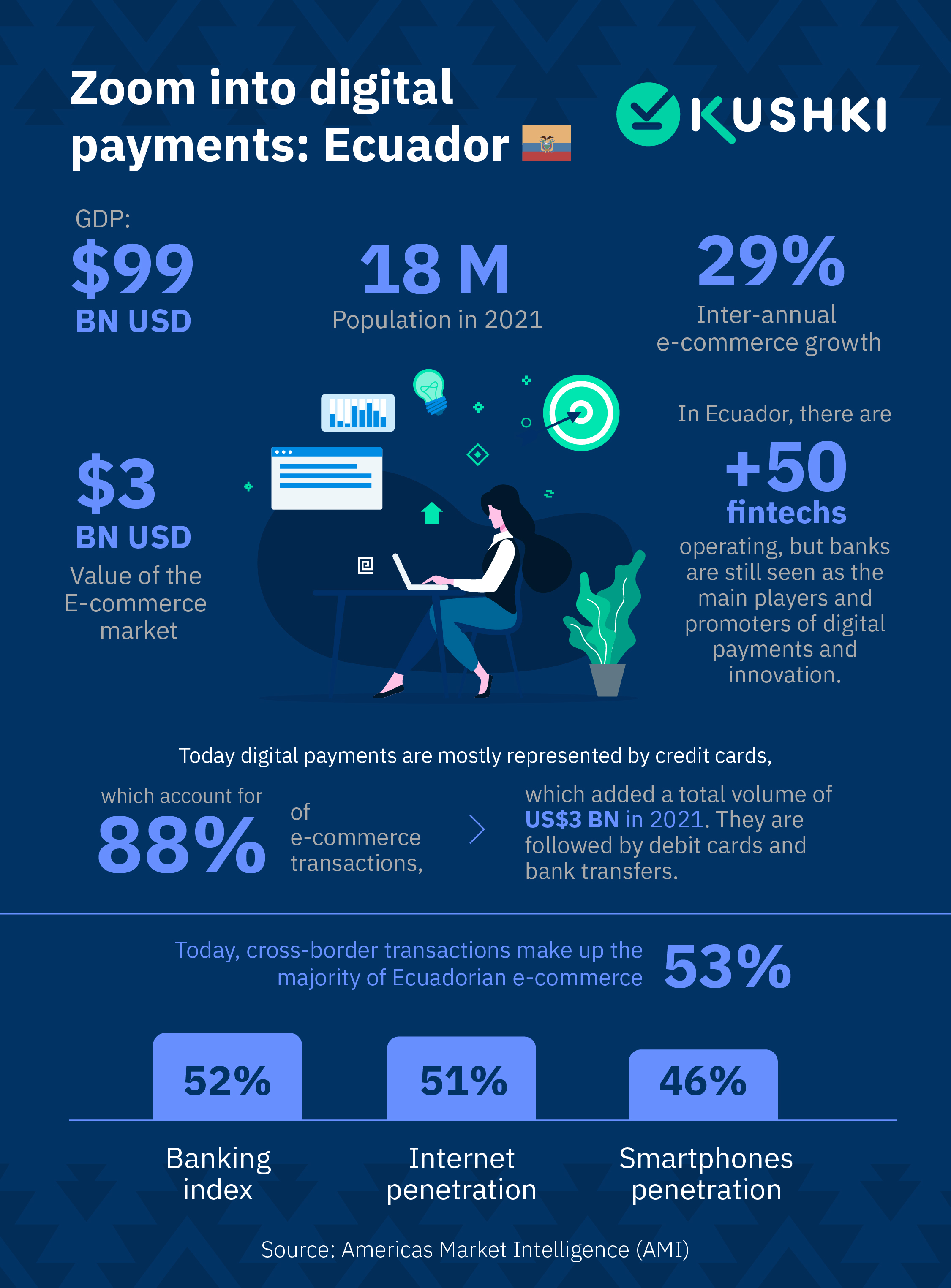
Did you know that Ecuador moves about US $3 billion in e-commerce transactions? That is equivalent to almost 3% of the country's GDP. The total volume of e-commerce in Ecuador grew by 29% between 2020 and 2021, and an increase of 22% is projected at the end of 2022.

Ecuador has an interesting characteristic unlike its neighbors: the high fidelity of the population towards traditional banks and financial institutions. Although more than 50 fintech companies are operating in the country, banks are still seen as the main players and promoters of digital payments and innovation.

About 88% of payments made in e-commerce in Ecuador are processed by credit card, followed by debit cards (6%), mobile wallets (5%), bank transfers (5%), and others (3%). To give a comparison, 4% of e-commerce transactions in countries like Peru are made through credit cards, 27% through debit cards, 18% through cash vouchers, and 13% through mobile wallets.

Additionally, cross-border transactions make up the majority of Ecuadorian e-commerce, but as local markets and delivery apps gain traction, the local market is also expanding.

Government efforts

In 2021, the Ecuadorian Congress passed a Fintech Law intending to support the growth of the Ecuadorian fintech sector and all its activity in recent years. Fintech companies in this country are governed by the COPCI Organic Code, which indicates the "development of software and services" as a priority sector for tax incentives. Under this code, fintech companies are exempt from income tax for five years from their launch, as a way to encourage activity.

If you are interested in knowing more about these companies and how the industry moves throughout LATAM, subscribe to our blog.

Infografia-AMI-ECU-02

Be the life of the party with the latest information on digital payments.

Subscribe to our Kushki Hub to receive alerts about our new content.

Suscribe illustration
Don't know which product is right for your business?
Does the world of payments catch your attention?

More about our kushki Hub

Kushki and AMI give us zoom on digital payments: Mexico

Latin America is a very multicultural region. Each country is a world, with very different customs among them. Purchasing habits and means of payment are no exception, because although there are countries where cash reigns, in others wallets or digital methods are gaining strength. We want to talk about all this together with Americas Market Intelligence (AMI), with whom we have collected information from each country in the region. Today, we will tell you about one of the largest markets in LATAM: Mexico. The e-commerce giant With a population of 130 million inhabitants and a GDP of US $1,293 million, Mexico is the second largest economy in Latin America. One of the factors that make the difference in its GDP is the remittances that are sent from the United States to that country: they have a year-on-year growth of approximately 27% and are the third largest recipient of remittances worldwide. Although it is a country that years ago already represented an interesting market for e-commerce, the closures caused by COVID-19 accelerated this exponentially. The volume of electronic commerce in that country reached US $49 BN at the end of 2021. One point to consider is the growing internet penetration rates (72%) and smartphones (69%) in Mexico. The opportunity for fintech companies Despite its size, Mexico is one of the countries where cash continues to rule the roost and an essential part of the population is underbanked. Almost half of the population does not have a bank account, so financial inclusion is a constant theme. It is for this reason that fintech companies in Mexico have experienced a boom, offering financial, banking, or payment services to the entire population that is currently not served. Paytechs like Kushki, which are a segment within fintech, bring digital payments closer to people by offering payments with cards, transfers, and often in cash, facilitating the adoption of these payment methods. This last point is very relevant in Mexico because almost 10% of the total volume of e-commerce in that country is paid with cash at face-to-face payment points. Also, the country has a tremendous number of companies of this type due to its regulation: Mexico has been one of the pioneers in having a Fintech Law to regulate financial technology institutions since 2018. The companies are directly supervised by the Central Bank of Mexico and the National Banking and Securities Commission (CNBV). If you want to know more about the different markets in the region and their behavior at the level of e-commerce and payments, subscribe to our blog and wait for the next deliveries with Americas Market Intelligence.
Avatar img
Magdalena Ovalle
Líder de Contenido @Kushki
septiembre 30, 2022

Kushki and AMI give us a zoom on digital payments: Chile

At Kushki we connect Latin America with payments, but we believe that this cannot be achieved without an understanding of the very multicultural region where we live. That's why we've partnered with Americas Market Intelligence (AMI) to collect data from our markets and deliver value. Today, we bring you the first installment, where we will talk about the southernmost country in our region: Chile. But first, let's go to the regional context. Digital Latin America In LATAM, more than three-quarters of the population owns a smartphone, the penetration of messaging applications and social networks is almost universal, and more than two-thirds of the population makes purchases online. Now that the majority of Latin Americans are connected, banks and digital wallets have dramatically increased their reach, rising from 30% penetration in 2017 to now exceeding 80% in the largest markets. With the inclusion of neobanks and digital wallets, access to banking in markets such as Colombia, Brazil and Argentina has reached almost 100% of adults. As a consequence of this, fintech companies are rewriting the economy of a region that has historically been underbanked, fragmented and with a high potential for improvement. According to Statista, in 2018 there were about 12,000 fintech companies globally and, at the end of 2021, this number reached more than 26,000. In Chile alone, between 2016 and 2021, fintech grew 3.2 times, showing that there are plenty of needs to attend. Chile: an ideal market for paytechs At a regional level, Chile is often considered the most advanced market in Latin America in terms of overall development. At around $15,000, its GDP per capita is almost double that of Brazil, and its stable currency and macroeconomic environment make it attractive to investors. It has 19 million inhabitants and an e-commerce market that reaches US $16 million, growing 19% year-on-year. Also, there is a low use of cash, which only represented 27% of retail volume in 2021. Why is this happening? The reasons are several: Chile is a leader in banking and smartphone penetration, debit cards are universally available and it is the first market in Latin America in penetration of contactless payments. For that very reason, the use of cash is low and infrequent. E-commerce in Chile is strong, experiencing growth from the pandemic, growing 52% and amassing US$16 billion in 2021. This is the first of our reports based on data from Americas Market Intelligence, join us to continue with the other countries.
Avatar img
Magdalena Ovalle
Líder de Comunicaciones Internas @ Kushki
septiembre 12, 2022

Kushki announces Billpocket acquisition to accelerate 3X its operation in Mexico

Kushki acquires Billpocket and will accelerate its operations in Mexico threefold The acquisition brings together Kushki’s knowledge and leadership of the regional online payment landscape and Billpocket’s deep understanding of card present payments Currently one of every 8 businesses that accept card payments in Mexico, use Billpocket’s payment solutions, this will unlock new strategic opportunities and will be a key element of Kushki’s plan to have a 3X growth in the country over the next months Kushki will continue to partner with all players of the payment ecosystem in Mexico and Latin America to strengthen the reduce the barriers and complexity of online and offline payments Mexico City, 17 of August, 2022. Kushki, the payment technology company that connects LatAm through payments, announced today that it has acquired Billpocket, a Mexican financial services platform that allows businesses to accept card payments. The acquisition brings together two best-in-class payment companies, combining Kushki's online expertise and regional positioning with Billpocket’s experience and know-how in card present payments. Coming just 2 months after Kushki reached Unicorn status and after registering a 200% regional growth in 2021, the acquisition is another step towards Kushki's mission of connecting LatAm through payments with the development of new, modern payment infrastructure for the region. Billpocket’s technology and offline payment infrastructure strengths Kushki’s consolidation in Mexico and the company expects a 3X growth in the next months. The acquisition highlights Kushki's strategy to partner and provide infrastructure to all players of the payment ecosystem, who are interested in taking advantage of the company’s solutions. At the same time, it will maintain its commitment to having an open ecosystem by serving and collaborating with any partner that wants to embed payments on their business strategies. “Since the moment we met Alejandro Guízar and his team at Billpocket, we were highly impressed with not only their expertise and knowledge of the card present payment solutions, but also with how much we shared a commitment to democratize payments in LatAm through new tech infrastructure. That’s why this acquisition was a very natural fit for both companies and we expect great things to come from it”, declared Aron Schwarzkopf, CEO and co-founder of Kushki. Founded in Guadalajara, Mexico over 10 years ago, Billpocket has a rich history servicing the Mexican payments market and became one of the first aggregators in the country, a key element to facilitating electronic payments by operating as an intermediary between banks and businesses. The more than 170 employees from Billpocket will remain as part of the company and will be part of a separate business unit inside Kushki, led by their founder, Alejandro Guízar. “This is the result of our work for over a decade, focusing on empowering entrepreneurs around Mexico and allowing businesses to grow. We are aligned with Kushki’s mission to connect LatAm with advanced electronic payment capabilities and now, with our technology and expertise combined, we’ll be able to work with even more partners across the region, contributing to the ever growing Paytech ecosystem. Being a Mexican company and with our devotion to the local ecosystem, it was key for us to partner with a company that has a strong focus and commitment with Mexico, and we found that in Kushki which is quickly becoming a local power player”, said Alejandro Guízar, Billpocket’s CEO and founder. Mexico is a key market for Kushki’s operation, being the region’s second-largest economy in Latin America and with an e-commerce scenario expected to be worth $146 USD billions by 2025. This growth is fueled by the recent digital payment boom, boosted by the social changes that the pandemic generated, a steady growth for the Internet penetration, which now covers 76% of the population and a high use of smartphones, which are now used by 69% of all Mexicans. The intent to acquire the company has already been approved by Mexico’s Comisión Federal de Competencia Económica, COFECE and the transaction is in the process of closing and is expected to be completed during the next couple of months.
Avatar img
Magdalena Ovalle
Líder de Contenido @Kushki
agosto 17, 2022