Financial inclusion and internet access: Colombia's formula to digitize

Avatar img
Magdalena Ovalle
Líder de Contenido @Kushki
noviembre 22, 2022
Lectura de 2 minutos
Financial inclusion and internet access: Colombia's formula to digitize

Colombia has positioned itself as a hotbed of fintech innovation in recent years. Do you want to know why? We will talk about the reasons for this and much more today in a new installment of Digitized Latin America, together with Americas Market Intelligence.

Digitization as a priority

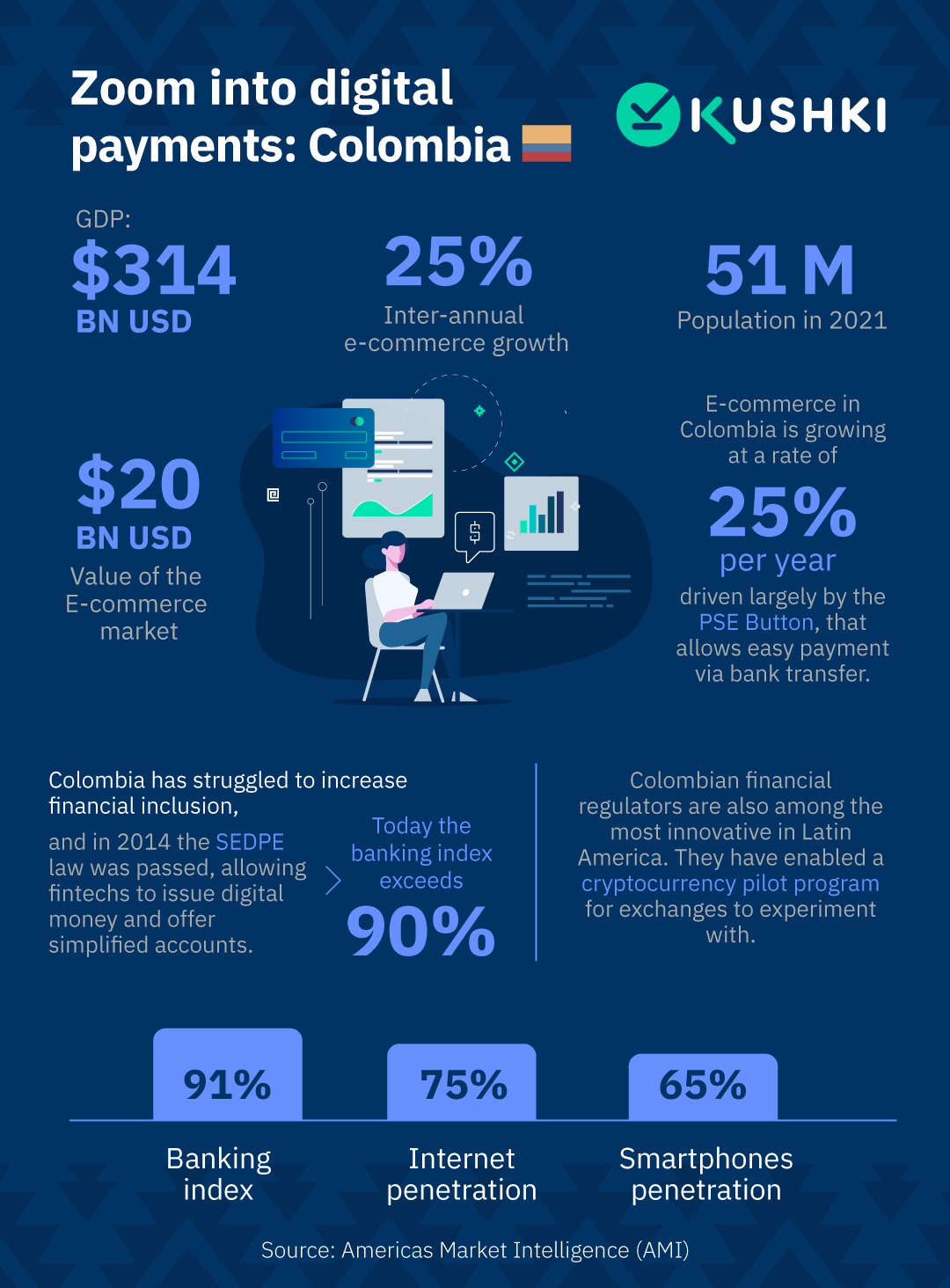
For several years, Colombia has been working to improve the financial inclusion of its population, which in 2021 reached 51 million people. In 2014, the SEDPE law was approved, which allows fintech companies to issue digital money and offer simplified accounts. With this regulation, financial inclusion has gradually increased over the years, and today the rate of access to banking services is over 90%.

Digital wallets also have an impressive share in Colombia, with 76% of the population using them. Super apps like DaviPlata, Nequi, or Movii enable public transport payments, social benefits, and even international remittances, among various other operations.

However, there is still a gap to work on in the country: internet access. Its mountainous geography means that only 26% of rural areas in Colombia have an internet connection. The government has taken on the task of solving this with three projects: Hogares Conectados, Navega TIC, and Zonas Digitales, which address aspects such as discounted internet rates, Wi-Fi access points, and the provision of free SIM cards.

E-commerce and new fintech models

Electronic commerce in Colombia has been growing at a rate of 25% per year, driven by the PSE button, an online payment button that allows a bank transfer as a payment method. The Colombian market has the highest share of bank transfers in payments for e-commerce, which demonstrates the need to implement other payment methods in addition to cards.

Regarding new models, in Colombia, the BNPL (Buy Now Pay Later) modality has been promoted with Addi, a company from that country that is gaining strength in this segment. The emergence of these companies is explained by the fact that Colombian financial regulators are among the most innovative in Latin America. For some years now, they have implemented a “crypto zone”, allowing cryptocurrency exchanges to experiment with deposit and withdrawal functionalities.

If you want to continue learning about digital payments in different countries of the region, review and subscribe to our blog.

Infografia-AMI-COL-02

Be the life of the party with the latest information on digital payments.

Subscribe to our Kushki Hub to receive alerts about our new content.

Suscribe illustration
Don't know which product is right for your business?
Does the world of payments catch your attention?

More about our kushki Hub

Peru: a promising market for electronic commerce

Peru: a promising market for electronic commerce

Last update: June 2025 Although it is not one of the largest countries in the region, Peru is positioned as one of the most vibrant markets with the greatest potential for digital growth in Latin America. With more than 34 million inhabitants, an expanding banking system, and increasing digital penetration, the country represents a great opportunity for the development of e-commerce and digital payments. In this edition, together with data from Americas Market Intelligence (AMI) and other updated sources, we explore the reasons why Peru is emerging as a strategic market for the digital economy. A turning point The pandemic triggered a structural transformation in Peru's e-commerce sector. In 2020, e-commerce grew by 55% year-on-year, and in 2021, it achieved an impressive 91% growth. Since then, digitization has maintained its momentum. By 2024, Peruvian e-commerce is estimated to reach USD $23 billion, with a year-on-year growth of 15%. This figure reflects a market that, although more mature than a few years ago, continues to consolidate thanks to consumer digital behavior and the greater availability of online payment solutions. Digital wallets have become a key tool in this evolution. According to recent figures, 72% of adults in Peru already use a digital wallet, with an average of 340 transactions per second. Platforms such as Yape, Plin, and Bim are leading this trend, even integrating segments traditionally excluded from the financial system. The public sector's impetus Since 2018, the Peruvian government has strongly promoted the digitization of the country. That year, Gob.pe was launched, a platform that centralizes government procedures and services and currently offers more than 7,000 digital services to citizens. During the pandemic, this commitment became even more relevant. The government launched the Yanapay subsidy, an economic benefit delivered through banks and digital wallets, which allowed thousands of underbanked people to be financially included. Today, the country reports that 65% of its population is now banked, a considerable increase over previous years. A digital infrastructure that enables growth In addition to advances in financial inclusion, Peru has an increasingly robust digital infrastructure: - Internet penetration: 74.7% - Smartphone penetration: more than 7.26 million units sold in 2024 (+27.6% vs. 2023) - Current GDP: USD $289 billion, with 3.3% growth These indicators reflect an environment ready to scale digital solutions, improve user experience, and boost conversion to digital channels. What's next for Peru? Peru continues to take firm steps toward a more digital, inclusive, and connected economy. The growth of e-commerce, the widespread use of digital wallets, increased internet access, and the government's commitment to digital transformation form a solid foundation for the country's future. For businesses and companies operating in Peru—or looking to enter the market—now is the ideal time to invest in modern, secure payment experiences that are aligned with new consumer preferences. Boost your digital growth in Peru with Kushki The payment ecosystem in Peru is evolving rapidly, and keeping up with digital consumer expectations is key to competing and growing. At Kushki, we connect merchants with the most innovative and secure payment solutions in the region, tailored to the challenges and opportunities of each market. 🚀 Are you ready to take your business to the next level in Peru? Let's talk. Discover how we can help you optimize your payments, increase your conversion rate, and provide a more seamless experience for your customers. 👉 Contact us here and let's get started today.
Avatar img
Magdalena Ovalle
Líder de Comunicaciones Internas @ Kushki
noviembre 03, 2022
Ecuador and its digital ecosystem: what opportunities exist?

Ecuador and its digital ecosystem: what opportunities exist?

Together with Americas Market Intelligence (AMI) we come to talk about Ecuador. A medium-sized country, but dollarized and with a highly loyal population to banks and financial institutions. What opportunities do fintech companies have there and what is the industry like? Here we tell you. Country context Did you know that Ecuador moves about US $3 billion in e-commerce transactions? That is equivalent to almost 3% of the country's GDP. The total volume of e-commerce in Ecuador grew by 29% between 2020 and 2021, and an increase of 22% is projected at the end of 2022. Ecuador has an interesting characteristic unlike its neighbors: the high fidelity of the population towards traditional banks and financial institutions. Although more than 50 fintech companies are operating in the country, banks are still seen as the main players and promoters of digital payments and innovation. About 88% of payments made in e-commerce in Ecuador are processed by credit card, followed by debit cards (6%), mobile wallets (5%), bank transfers (5%), and others (3%). To give a comparison, 4% of e-commerce transactions in countries like Peru are made through credit cards, 27% through debit cards, 18% through cash vouchers, and 13% through mobile wallets. Additionally, cross-border transactions make up the majority of Ecuadorian e-commerce, but as local markets and delivery apps gain traction, the local market is also expanding. Government efforts In 2021, the Ecuadorian Congress passed a Fintech Law intending to support the growth of the Ecuadorian fintech sector and all its activity in recent years. Fintech companies in this country are governed by the COPCI Organic Code, which indicates the "development of software and services" as a priority sector for tax incentives. Under this code, fintech companies are exempt from income tax for five years from their launch, as a way to encourage activity. If you are interested in knowing more about these companies and how the industry moves throughout LATAM, subscribe to our blog.
Avatar img
Magdalena Ovalle
Líder de Contenido @Kushki
octubre 19, 2022
Kushki and AMI give us zoom on digital payments: Mexico

Kushki and AMI give us zoom on digital payments: Mexico

Latin America is a very multicultural region. Each country is a world, with very different customs among them. Purchasing habits and means of payment are no exception, because although there are countries where cash reigns, in others wallets or digital methods are gaining strength. We want to talk about all this together with Americas Market Intelligence (AMI), with whom we have collected information from each country in the region. Today, we will tell you about one of the largest markets in LATAM: Mexico. The e-commerce giant With a population of 130 million inhabitants and a GDP of US $1,293 million, Mexico is the second largest economy in Latin America. One of the factors that make the difference in its GDP is the remittances that are sent from the United States to that country: they have a year-on-year growth of approximately 27% and are the third largest recipient of remittances worldwide. Although it is a country that years ago already represented an interesting market for e-commerce, the closures caused by COVID-19 accelerated this exponentially. The volume of electronic commerce in that country reached US $49 BN at the end of 2021. One point to consider is the growing internet penetration rates (72%) and smartphones (69%) in Mexico. The opportunity for fintech companies Despite its size, Mexico is one of the countries where cash continues to rule the roost and an essential part of the population is underbanked. Almost half of the population does not have a bank account, so financial inclusion is a constant theme. It is for this reason that fintech companies in Mexico have experienced a boom, offering financial, banking, or payment services to the entire population that is currently not served. Paytechs like Kushki, which are a segment within fintech, bring digital payments closer to people by offering payments with cards, transfers, and often in cash, facilitating the adoption of these payment methods. This last point is very relevant in Mexico because almost 10% of the total volume of e-commerce in that country is paid with cash at face-to-face payment points. Also, the country has a tremendous number of companies of this type due to its regulation: Mexico has been one of the pioneers in having a Fintech Law to regulate financial technology institutions since 2018. The companies are directly supervised by the Central Bank of Mexico and the National Banking and Securities Commission (CNBV). If you want to know more about the different markets in the region and their behavior at the level of e-commerce and payments, subscribe to our blog and wait for the next deliveries with Americas Market Intelligence.
Avatar img
Magdalena Ovalle
Líder de Contenido @Kushki
septiembre 30, 2022